Saturday, July 03, 2010

day-to-day


The last couple of weeks I’ve spent reflecting. I’ve settled into the routine of the day to day and have more time and energy to think about the big picture. Here is some insight into my favorites here in Namungalwe...

My runs…I haven’t been as consistent as I am at home, when greenlake is right outside my door, an easy 3 mile loop, but I have made an effort to try to run 3 days a week here. I’ve been saving them toward the end of the day when I’m already hot and sticky. It takes a bit of effort to put on the spandex capris, sports bra and running shoes (that are now encrusted in Ugandan dirt). However, that effort is well worth it when I start out on the dirt path and wind my way through the village. Children on their way home from school sometimes join me. Of course, their feet aren’t protected by cushioned soles from the pounding on the gravel/dirt roads. They don’t care…or even seem to notice, but instead run right behind you smiling…huge smiles. Sometimes people ask me, “Madame, where are you running?” And I say, “nowhere, just running.” You start to feel guilty when you don’t respond to every call…”mzungu, mzungu, how are you?” “jambo, rebekah!” It’s flattering they remember my name, even though I will probably never remember theirs. I’ve started into the habit of jumping into the occasional soccer match in a front yard, stopping to chat and giggle with some teenage girls, or pump water at the well. It’s always an adventure, a somehow calm release from the work we’re doing.

My showers…yes, it would make sense that this favorite would follow the first. I make my way back to the house, enjoying the sunset. I take off my socks and running shoes and put on my flip-flops, grab my night clothes (loose pants and ¾ sleeve shirt) and fill the basin with water. I try not to use too much, as we only have 3 jerricans among the six of us living in the house. We’ve designated a cup to use for showering and I love the feel of pouring a full cup of water over my head and the coolness as it trails down my body. I feel exposed in the bathing area. It is a small cubicle on the other side of 2 latrines with eye-level cement walls. I could be in and out in less than a couple of minutes, but I enjoy taking my time to feel clean, to shampoo and condition my hair and to slough away the dirt from my feet with a washcloth that I end up cleaning almost daily. My running clothes make their way to the line to dry for the next day…the sweat accumulating over the week until I do laundry. Feeling fresh and clean is a momentary pleasure here, and I relish it.

My host family…I say host family, but really that isn’t their official title. We live in the home of Dr. Lukandwa. He works in Kampala, about a 3 hour drive away. The compound has two houses a kitchen and a building for the animals (not quite a barn though). The yard is huge and has a prominent mango tree in the front which the village uses as its main gathering place. It is private, set far from the street, although occasionally in the morning and afternoon as children walk by to and from school, I’ll see bright orange, pink or blue uniforms with arms waving from them at us. Our house is situated in front and the sister of the doctor runs the household that occupies the second house. She is definitely the in-charge and maintains the property. The property includes three cows (ente), a handful of goats (mbuzi)…the kids laugh at my goat impression, chickens…including the baby chicks in different stages of growth from cute fresh chick to awkward, almost ugly adolescent, and of course the rooster…he reminds me of his presence or should I say dominance every morning well before the sun is up and then constantly throughout the day whenever he feels is necessary. But of course the highlight is not really the animals, although I do love them and love the scene of the yard when the cow is laying lazily chewing its cud at that perfect time in the early evening when the light is just right, but even more so I love Mutesi (sister of the doctor, who runs the household), Joy, Nicholas, Helen and Lilian (the younger children 11-16 years who are all somehow or another connected to the family). You never know who belongs to who, but it doesn’t matter here. The family isn’t an isolated unit of mother, father and children. It consists of sisters, brothers, nephews, nieces, grandmothers, aunts…some of who are not even blood related. Everyone has their role that keeps the compound alive and running. Lillian leads the goats in at nightfall, Joy fetches the water and helps with dinner, Nicholas kills the chicken and works on laundry, Helen waters the cows and everyone helps in the garden…filled with matooke, groundnuts, potatoes, cassava, papayas, and coffee beans. Overseeing all of this is Mutesi, who has become a good friend and protector. She is always looking out for us and helps me with my lusoga and always appreciates when I come out to help with dinner or in the field. My favorite was when she told me I was a “good girl” because I was off to shower. She works hard, all day. She is a strong woman, but has a limp from a hip problem…she walks slowly but deliberately and I love her. The kids are all off to school by the time I’ve finished my morning coffee, so most of my interactions with them are in the evening when I go to help peel potatoes or dice cassava. Language is a barrier. Some speak better English than others. They try to teach me Lusoga…my favorites are stars – munyenye and moon – omwezi…probably because it is at night when my lessons begin and we are sitting out under the expanse of dark sky filled with the brightest stars and moon. The laugh at my accent and attempted pronunciations of the long words filled with an unusual number of vowels. Soon we’re taking turns singing songs in English and lusoga and maybe Helen or Lilian will even dance. Mutesi is quick to correct them when they fumble in translation and I know she loves it as much as they do. There are others that live at the house, whose relation I do not know, but everyone is so polite and generous. Granted, most of Ugandans are…a signature of their culture, one of long greetings and generosity. I will miss my family here.
2010-07-02 malaria outreach


Make sure to read the captions...

Friday, July 02, 2010

Last couple of weeks....


It’s been awhile since I’ve been able to blog from Uganda. Unpredictable internet speed and availability is the main problem. It’s also difficult to keep up on my journal without electricity to recharge my computer every few days. So I’ll have to do a quick recap of the last couple of weeks.
Most of last week, I was anxiously awaiting my MCAT scores. I had my parents check the day they were out, but didn’t hear until the following afternoon due to time difference and cell service. I was so relieved when I found out I had exceeded my goal score by a point, but also immediately wished the score was better. But that’s usually how it goes…never satisfied.
We had our Safe Water/Sanitation outreach Thursday of that week and I think it was a success. We prepared and made visuals the few days before, mobilized the community by putting up posters at the boreholes and then went house-to-house as well, which was somewhat inefficient as we only have 2 lusoga/luganda speakers on our team. However, we had a pretty good turn out; even if we had to wait about 2 hours after the posted meeting time, but that’s African time. You say 2pm and people show up at 4, 4;30 or even 5pm. We may consider it rude in America, but that’s just the way it is here. I had made an outline of our lesson of sorts and we tried to make it as interactive and interesting as possible. We had one rogue attendee who enjoyed asking absurd questions. One example was when we were introducing waterguard as an option to treat your water. It is a chemical based treatment and you pour a capful into a 20L jerrican. The man asked, “ you say it kills and cleans everything, what’s not to stop someone from using it to clean their clothes, or eye, or maybe they’ll just pore the whole thing down the borehole….” I thought he was rather entertaining and made the crowd laugh, even if he was a bit unruly. We sold a few bottles of waterguard, but most of the women didn’t bring money, so hopefully they’ll be back.
That weekend we went to Jinja for the day on Saturday to indulge in a mocha and use the wireless at flavours cafĂ©. I started looking over my AMCAS (med school) application and freaked out a little about all the information I have to input about courses and what not. I wasn’t able to spend much free time as I was focused on emailing out about letters of rec and transcript requests. We left Jinja feeling refueled and recharged for the week ahead and excited about watching the US/Ghana game later that night in the village. Transportation in Uganda is a bit sketch and unpredictable. In order to get to jinja (about a 45 min drive from iganga) our team has to walk about 10 minutes to catch a boda boda in our village marketplace to get to iganga (about a 20 minute ride). We then go to the taxi (or matatu) park where we wait for a van-like taxi to leave for Jinja, sometimes you wait 10 minutes, sometimes you wait an hour. We could catch one en route off the main road, but when you travel with a larger group it’s better to wait in the taxi park. This is because Africans don’t abide by obvious car safety standards…like how many people can fit in a row of seats. You would think you would have one person per seat, but that isn’t very profitable so they tend to squeeze one, maybe two extras in. You can imagine this makes for a fairly uncomfortable ride, especially when you factor in all the stops as people get off at different stages and then conductors frantically wave at passerbys to see if they need a ride. It can create a jerky and long ride. On the way home from Jinja that day our matatu actually stopped about 10 minutes outside of iganga and everyone except the Americans got out…we were confused, thinking we would continue on, but after waiting about 10 minutes, being harassed by vendors to buy everything under the sun…one teenage boy even asked Sean if he could buy one of us girls…..what??? Anyway, after we put up a bit of a stink we were shuffled onto yet another matatu that finished the drive to iganga. Later that night we went to “the barn,” a random building in the village that broadcasts the world cup games. It was heartbreaking watching the US lose to Ghana…I feel like the African audience was exceptionally proud and rowdy with a group of Americans in their midst.

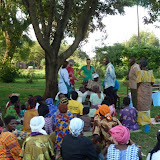
The next week we spent preparing and mobilizing for our malaria outreach, meeting with the Namungalwe health center management committee and building a tippy-tap in the primary school after teaching about sanitation and handwashing. The malaria outreach went well on Thursday. We put up posters on Wednesday and Nina and I rode bikes around the village reading off one of the posters in lusoga, inviting people to come. It was fun to try to communicate on our own without an interpreter and people were surprised we were able to ride bikes and were excited we had come to tell them about the sensitization. There were about 50 people that trickled in from about 4:30 to 6pm…over 2 hours after it was supposed to start. We shared about transmission, dispelling local myths, talked about what types of treatments are effective and how to prevent mosquito bites…we pushed using long-lasting insecticide treated nets and sold about 25 after the outreach. I was distracted by the neighbor kids after our presentation and ended up having a photo shoot with them instead of interacting with the adults. Mpulu…a cute little boy who cries if a white person gets too close, was especially adorable and I was able to get some great pictures and play Frisbee with him…one time accidently hitting him in the forehead…oops. I think though he is on his way to overcoming his fear of white people…although the Frisbee incident probably didn’t help much at all.


Yesterday (Friday), we came into Iganga for a mid-trip debrief. Teams were able to share about their work so far and talk about what they hoped to accomplish over the next couple of weeks. We also talked more about what the Village Health Team will look like and heard from the health care team, which is working with the health centers and the follow up team, which is looking in on last years VHT’s. I’m sure I’ll have more to write about that after I process all that was said. I had a great conversation with our Ugandan team leader about the health care and political system here in Uganda, which I’ll share more on later. For now, I just hope to be able to post these couple of blogs and latest pics!
Iganga shoppers...where i buy my yogurt I drink with a straw and apples...imported apples

LinkWithin

Related Posts Plugin for WordPress, Blogger...